
Your senior engineer walks in Monday morning, opens the PSA, and sees forty-three tickets in the unassigned queue. Before touching a single client issue, they’ll spend twenty to forty minutes reading descriptions, checking client contracts, cross-referencing SLAs, and deciding who should handle what. By 10:30am, they’ve solved precisely nothing, but they’ve become an expensive sorting machine.
This is triage paralysis, and it’s eating your margins alive. When engineers earning £35,000 to £45,000 annually spend their first two hours each day categorising tickets instead of closing them, you’re burning through your service desk budget before any actual service happens. In practice we see this pattern repeatedly across MSPs of all sizes, the Monday morning queue becomes a reliable margin drain before the working week has properly started. It’s one of the core problems DaemonLayer was built to solve.
HDI benchmarks put average triage handle time at approximately eight minutes for L1 tickets. In an MSP processing significant monthly volumes, that’s two to three engineer hours every day spent just working out what each ticket actually is. Your engineer reads the description, checks the client’s service level, considers which team member has capacity, then assigns and updates the ticket.
But here’s what the benchmarks don’t capture: context switching cost. Every time an engineer stops solving problems to sort through new arrivals, they lose focus on the technical work they were hired to do. Each ticket requires eight minutes to triage, then based on UC Irvine research into workplace interruptions, over twenty minutes to regain full focus on complex technical work afterwards. Among ConnectWise MSPs processing 2,000 or more tickets per month, this secondary cost rarely appears in time-tracking data, but it shows up clearly in tickets-closed-per-engineer figures.
The real expense isn’t the triage time itself. It’s that your best problem-solvers become administrators by default.
Most MSPs run their service desk through a PSA like Autotask, ConnectWise, or HaloPSA, then wonder why engineers still struggle with ticket prioritisation. The PSA captures the ticket, stores the conversation, and tracks time to resolution. But it doesn’t interpret the actual request.
Engineers end up jumping between the PSA for ticket management, knowledge bases like IT Glue for resolution steps, password vaults like NordPass or Keeper for credentials, client M365 tenants for the actual work, and RMMs like Datto for server issues. Each ticket becomes a research project across multiple platforms before any technical work begins. This tool fragmentation is one of the core challenges our AI service desk platform was designed to address, bringing ticket interpretation, routing, and resolution steps into a single workflow rather than forcing engineers to context-switch between systems.
The PSA was designed to organise information, not to understand it. When tickets arrive with subject lines like “Can’t access email” or “Printer not working”, an engineer still needs to read, interpret, and categorise before they know whether this is a two-minute password reset or a three-hour network troubleshooting session.
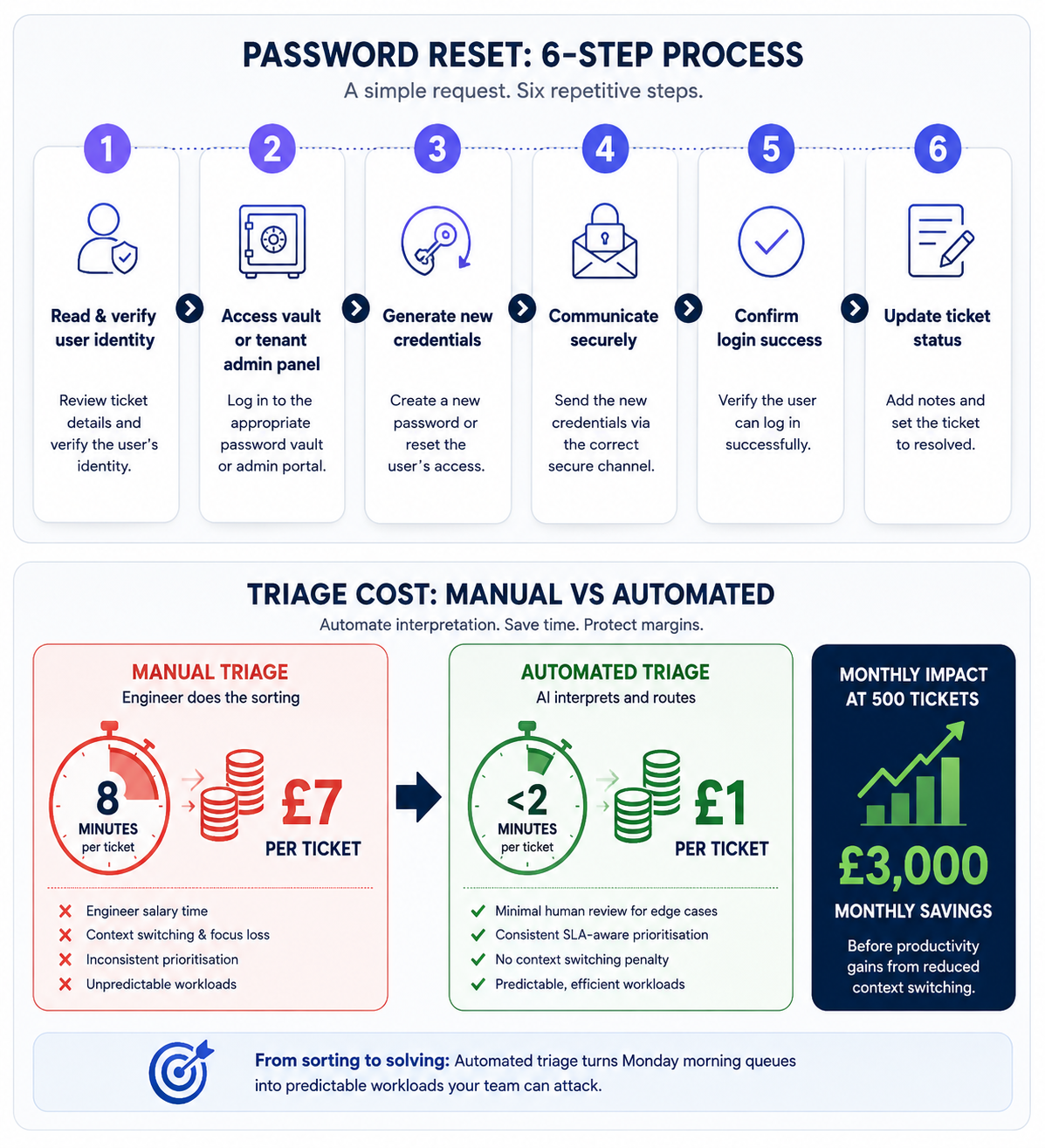
Password resets are consistently cited as the highest-volume L1 request type across MSP benchmarks, yet most service desks handle each one as if it’s the first they’ve ever seen. The engineer handles each password reset by working through the following steps:
The process becomes automatic, which should make it faster. Instead, it makes it mind-numbing. The pattern we observe when working with service desk teams is telling: engineers trained in network architecture and system administration spend significant portions of their day following password reset checklists, and the frustration is visible well before it shows up in turnover data. MSP engineer turnover is a persistent industry problem, and the exit interviews don’t usually cite the complexity of the technical challenges. We looked at the margin impact of this dynamic in more detail in our post on why your most common ticket is killing your bottom line.
 If you want to see what it looks like when this work is handled before engineers open the queue, that is what DaemonLayer was built to do.
Tickets arrive through email, phone calls get logged manually, Slack messages need transferring to the PSA, Teams notifications interrupt focused work, and WhatsApp messages from VIP clients bypass the queue entirely. Each channel feels urgent to the person using it, but creates triage overhead for your team.
Ticket variability creates operational inefficiency. When tickets arrive pre-categorised and routed automatically, engineers can work in batches: handle all password resets in sequence, then switch to network issues, then move to software installations. When every ticket is a mystery box requiring investigation before work can begin, engineers spend their day context-switching between different types of problems and different client environments.
Varying SLAs across different client tiers add another layer of complexity. A ticket that looks routine might actually be priority one because it affects a premium client’s operations. Without automated triage that understands client service levels, engineers either over-prioritise everything to be safe, or miss truly urgent issues buried in the general queue.
Automated interpretation eliminates most triage overhead. When AI can read incoming tickets, identify the request type, check client service levels, and route to the appropriate engineer or automated workflow, triage time drops from eight minutes to under two minutes per ticket.
Based on UK service desk salary benchmarks, manual triage costs approximately £7 per ticket at eight minutes of engineer time. Automated triage brings that closer to £1 per ticket, the cost of the AI processing plus the minimal human review required for edge cases. At five hundred tickets per month, that’s £3,000 in monthly savings before you account for the productivity gains from reduced context switching. For a practical look at how these numbers play out at different ticket volumes, see our MSP service desk ROI calculator.
The MSPs seeing the clearest margin improvement from automation aren’t necessarily the ones with the highest ticket volumes. They’re the ones where triage was creating the most unpredictability, where engineers never knew whether the next ticket would take two minutes or two hours, and planned their days accordingly by assuming everything would be complex.
Automated triage doesn’t just save time. It makes your service desk predictable, which lets engineers plan their work, batch similar tasks, and actually use the technical skills you’re paying for. The Monday morning queue stops being a sorting problem and starts being a workload your team can attack systematically.
Triage paralysis is the pattern where engineers spend more time sorting, categorising, and assigning incoming tickets than they do resolving them. It occurs when tickets arrive without context, priority, or routing information attached, forcing skilled engineers to act as administrators before any technical work can begin. At high ticket volumes it becomes a structural margin problem rather than an individual performance issue.
Based on UK service desk salary benchmarks and HDI handle time data, manual triage costs approximately £7 per ticket at an average of eight minutes of engineer time. Automated triage reduces that to approximately £1 per ticket. At 500 tickets per month that difference represents around £3,000 in monthly savings before accounting for the productivity gains from reduced context switching.
PSA platforms are designed to organise and track tickets once they exist, not to interpret incoming requests or assemble context across systems. An engineer using a PSA still needs to read the ticket, cross-reference the client contract, check service levels, and decide on routing manually. The PSA captures that work but does not replace it.
Research from the University of California, Irvine found that recovering full focus after a workplace interruption takes over twenty minutes on average. In a service desk environment where engineers are interrupted repeatedly throughout the day to sort incoming tickets, this compounds into several hours of lost productive capacity per engineer per week.
Kevin Wright
Co-founder & CEO, DaemonLayer
Kevin built and exited an IT services business before working in M&A and then as Operations Director at an MSP. He holds an MBA from the University of Manchester. He founded DaemonLayer to fix the coordination problems he watched erode engineer capacity firsthand.
Connect on LinkedIn →